Fitness Plan for Beginners Your Journey Starts Now
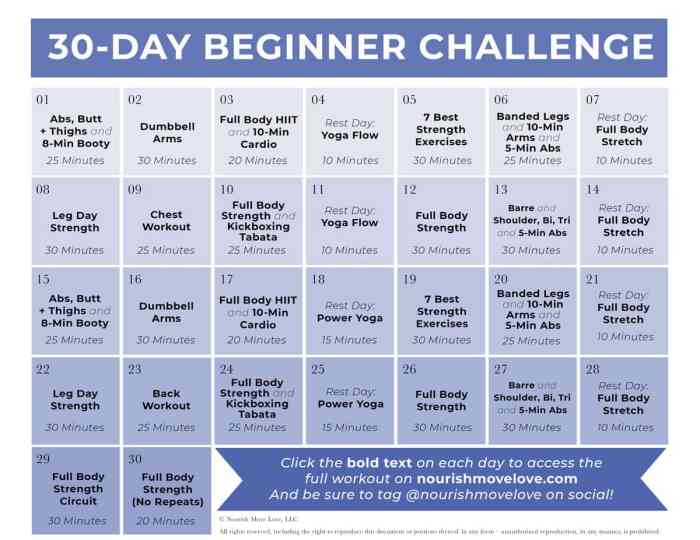
Fitness Plan for Beginners: Embark on a transformative journey towards a healthier, stronger you. This comprehensive guide provides a structured approach to fitness, catering to individuals with little to no prior experience. We’ll explore various workout styles, from bodyweight exercises to yoga and cardio, emphasizing safety, proper form, and gradual progression. Whether your goal is weight loss, increased strength, or simply improved well-being, this plan offers a roadmap to success.
We understand that starting a fitness routine can feel daunting. That’s why we’ve designed this plan to be accessible, adaptable, and motivating. You’ll learn fundamental exercises, understand the importance of listening to your body, and discover strategies to stay consistent with your fitness goals. Let’s build a sustainable fitness habit together.
Defining a Beginner Fitness Plan
Embarking on a fitness journey can be incredibly rewarding, but it’s crucial to start safely and effectively. A well-structured beginner fitness plan prioritizes gradual progress, preventing injuries and fostering long-term adherence. This plan focuses on building a solid foundation of strength, endurance, and healthy habits.A safe and effective beginner fitness plan incorporates several key components. These components work synergistically to promote fitness gains while minimizing the risk of injury.
Ignoring any of these elements can significantly reduce the effectiveness and increase the risk of setbacks.
Essential Components of a Beginner Fitness Plan
A successful beginner’s fitness plan should include a balanced combination of cardiovascular exercise, strength training, flexibility exercises, and adequate rest. Cardiovascular exercise improves heart health and endurance. Strength training builds muscle mass and bone density. Flexibility exercises enhance range of motion and prevent injuries. Finally, sufficient rest allows the body to recover and adapt to the training stimulus.
Ignoring any of these components will result in an incomplete and potentially less effective program.
Gradual Progression in Fitness
Gradual progression is paramount for beginners. Starting too intensely can lead to burnout, injuries, and ultimately, abandoning the fitness plan altogether. The body needs time to adapt to new stresses. A gradual increase in intensity, duration, and frequency of workouts allows for safe and sustainable progress. For example, instead of immediately running for 30 minutes, a beginner might start with 10 minutes of brisk walking, gradually increasing the duration and intensity over several weeks.
This measured approach is key to long-term success and injury prevention.
Sample Weekly Beginner Fitness Schedule
This sample schedule incorporates rest days crucial for recovery and prevents overtraining. Remember to listen to your body and adjust as needed.
| Day | Activity | Duration | Intensity |
|---|---|---|---|
| Monday | Cardio (brisk walking or cycling) | 20 minutes | Moderate |
| Tuesday | Strength Training (bodyweight exercises) | 30 minutes | Low to Moderate |
| Wednesday | Rest | – | – |
| Thursday | Cardio (brisk walking or cycling) | 25 minutes | Moderate |
| Friday | Strength Training (bodyweight exercises) | 30 minutes | Low to Moderate |
| Saturday | Flexibility and Stretching | 15 minutes | Low |
| Sunday | Rest or Active Recovery (light walk) | – | – |
Note: Bodyweight exercises could include squats, push-ups (on knees if needed), lunges, planks, and glute bridges. Adjust the duration and intensity based on your fitness level and how you feel.
Importance of Consulting a Healthcare Professional
Before starting any new fitness routine, it is highly recommended to consult a healthcare professional, especially if you have pre-existing health conditions. A doctor or physical therapist can assess your current health status, identify any potential risks, and provide personalized recommendations. This consultation can help prevent injuries and ensure the fitness plan aligns with your individual needs and capabilities.
This proactive approach is crucial for maximizing the benefits and minimizing the risks associated with exercise.
General Fitness Guides for Beginners
Embarking on a fitness journey can feel daunting, but with a structured approach and a focus on foundational principles, beginners can build a solid base for long-term health and well-being. This guide provides essential information to help you navigate your initial steps towards a fitter lifestyle.
Successful fitness plans hinge on several key elements. Understanding these fundamental principles ensures a safe and effective workout experience, maximizing results and minimizing the risk of injury.
Fundamental Principles of Exercise for Beginners, Fitness Plan for Beginners
Consistency is key when starting a fitness program. Beginners should aim for at least 150 minutes of moderate-intensity aerobic activity or 75 minutes of vigorous-intensity aerobic activity per week, spread throughout the week. This can be achieved through brisk walking, jogging, cycling, or swimming. Incorporating strength training exercises, targeting all major muscle groups, at least two days per week is also crucial for building strength and improving overall fitness.
Remember to prioritize proper form over the amount of weight lifted. Start with lighter weights or bodyweight exercises and gradually increase the intensity as your strength improves. Finally, adequate rest and recovery are vital for muscle repair and growth. Aim for at least one or two rest days per week to allow your body to recover.
Proper Form and Technique for Common Exercises
Maintaining correct form during exercise is paramount to prevent injuries and maximize the effectiveness of each movement. Let’s examine proper technique for some common exercises.
For example, when performing squats, ensure your feet are shoulder-width apart, your back is straight, and your chest is up. Descend until your thighs are parallel to the ground, keeping your weight in your heels. Push back up to the starting position using your legs and glutes. Another example is the push-up. Maintain a straight line from head to heels, engaging your core muscles.
Lower your body until your chest nearly touches the floor, then push back up, focusing on controlled movements. For lunges, step forward with one leg, bending both knees to 90 degrees, keeping your front knee aligned with your ankle. Push off with your front foot to return to the starting position. Remember, proper form is more important than the number of repetitions.
Tips for Staying Motivated and Consistent
Maintaining motivation and consistency is crucial for achieving long-term fitness goals. Set realistic and achievable goals, starting with smaller milestones to build momentum. Find an exercise buddy for support and accountability. Vary your workouts to prevent boredom and challenge your body in different ways. Reward yourself for reaching milestones, focusing on non-food rewards.
Remember to track your progress, noting both your physical and mental improvements. This can be as simple as keeping a journal or using a fitness app. Finally, celebrate your successes and acknowledge that setbacks are a normal part of the process.
Recognizing Signs of Overtraining
Overtraining can hinder progress and lead to injury. Pay close attention to your body’s signals. Persistent muscle soreness, fatigue, decreased performance, loss of motivation, and changes in sleep patterns are all potential indicators of overtraining. If you experience these symptoms, reduce the intensity or frequency of your workouts, prioritize rest and recovery, and consider consulting a healthcare professional.
Listening to your body is key to preventing burnout and ensuring sustainable fitness progress. Remember that rest is just as important as exercise in building strength and achieving your fitness goals.
Home Workouts for Beginners
Starting a fitness journey at home offers convenience and accessibility. This section details effective bodyweight exercises, a sample workout routine, and considerations for various fitness levels, along with the advantages and drawbacks of home-based fitness.
Bodyweight exercises are a fantastic way to build strength and endurance without any equipment. They utilize your own body weight as resistance, making them ideal for beginners who are just starting their fitness journey. The exercises below are adaptable to different fitness levels, allowing for progression as you get stronger.
Effective Bodyweight Exercises for Beginners
The following exercises target major muscle groups and can be easily performed at home. Remember to focus on proper form to prevent injuries and maximize results. Start with fewer repetitions and gradually increase as you feel more comfortable.
- Squats: Works legs and glutes. Stand with feet shoulder-width apart, lower your hips as if sitting in a chair, keeping your back straight and chest up.
- Push-ups: Works chest, shoulders, and triceps. Start on your hands and knees, lower your chest towards the floor, and push back up. Modify by doing push-ups against a wall or on your knees for easier variations.
- Lunges: Works legs and glutes. Step forward with one leg, bending both knees to 90 degrees. Alternate legs.
- Plank: Works core muscles. Hold your body in a straight line from head to heels, supported by your forearms and toes.
- Glute bridges: Works glutes and hamstrings. Lie on your back with knees bent and feet flat on the floor. Lift your hips off the floor, squeezing your glutes at the top.
- Walking Lunges: A dynamic variation of lunges, increasing cardiovascular involvement.
- Incline Push-ups (against a wall): Easier variation of standard push-ups for beginners.
A 30-Minute Home Workout Routine
This routine combines cardio and strength training for a well-rounded workout. Remember to warm up for 5 minutes before starting (e.g., light cardio like jumping jacks or high knees) and cool down for 5 minutes afterward (e.g., stretching).
- Jumping Jacks (2 minutes)
- Squats (3 sets of 10-12 repetitions)
- Push-ups (3 sets of as many repetitions as possible – AMRAP)
- Lunges (3 sets of 10-12 repetitions per leg)
- Plank (3 sets, hold for 30 seconds)
- Glute Bridges (3 sets of 15-20 repetitions)
- Rest (1 minute)
- Repeat the circuit once or twice.
Modifying Exercises for Different Fitness Levels
Adjusting the intensity of exercises is crucial for safety and progress. Beginners should focus on proper form over the number of repetitions. As fitness improves, increase the number of repetitions, sets, or the difficulty of the exercise.
- Reduce repetitions/sets: Start with fewer repetitions and sets to avoid overexertion. Gradually increase as your fitness improves.
- Modify exercise variations: Use easier variations of exercises like incline push-ups instead of standard push-ups or knee push-ups instead of full push-ups.
- Increase resistance: As you get stronger, you can add resistance by using weighted objects or resistance bands (if available).
- Increase workout duration: Gradually increase the duration of your workout sessions as your stamina improves.
Benefits and Limitations of Home-Based Workouts
Home workouts offer several advantages, but also have limitations. Understanding both is important for setting realistic expectations.
- Benefits: Convenience, cost-effectiveness, flexibility in scheduling, and privacy.
- Limitations: Limited equipment access, potential for lack of motivation, less structured environment, and reduced access to expert guidance.
Yoga and Meditation for Beginners
Incorporating yoga and meditation into a beginner’s fitness plan offers numerous benefits beyond physical strength and endurance. These practices cultivate a holistic approach to well-being, addressing mental and emotional health alongside physical fitness. This section will explore the advantages of these practices and provide a practical guide for beginners.
Benefits of Yoga and Meditation for Beginners
Yoga and meditation provide a powerful combination for enhancing physical and mental well-being. Yoga improves flexibility, strength, balance, and coordination, while simultaneously reducing stress and promoting relaxation. Meditation, on the other hand, cultivates mindfulness, focus, and emotional regulation, helping to manage stress and improve sleep quality. The combined practice fosters a sense of calm and centeredness, enhancing overall quality of life.
Regular practice can lead to improved cardiovascular health, reduced blood pressure, and increased energy levels. Furthermore, the mindful movements of yoga can improve body awareness and reduce the risk of injury during other forms of exercise.
Beginner-Friendly Yoga Sequence
This sequence focuses on basic poses to build strength, flexibility, and mindfulness. Remember to listen to your body and modify poses as needed.
- Mountain Pose (Tadasana): Stand with feet hip-width apart, grounding down through your feet. Lengthen your spine, relax your shoulders, and engage your core. Hold for 1 minute, focusing on your breath.
- Downward-Facing Dog (Adho Mukha Svanasana): From a tabletop position, lift your hips up and back, forming an inverted V-shape. Pedal out your feet to stretch your hamstrings and calves. Hold for 1 minute.
- Plank Pose: From downward-facing dog, shift your weight forward to come into a plank position. Maintain a straight line from head to heels, engaging your core and glutes. Hold for 30 seconds.
- Cobra Pose (Bhujangasana): Lie on your stomach, hands under your shoulders. Press into your hands to lift your chest off the floor, keeping your shoulders relaxed. Hold for 30 seconds.
- Child’s Pose (Balasana): Kneel on the floor, big toes touching. Sit back on your heels (as best as you can) and fold forward, resting your forehead on the mat. Extend your arms forward. Hold for 1 minute.
- Triangle Pose (Trikonasana): Stand with feet wide apart. Turn your right foot out 90 degrees and your left foot slightly inward. Extend your arms to the sides. Bend to the right, reaching your right hand towards your ankle and extending your left hand towards the ceiling. Hold for 30 seconds, then repeat on the other side.
- Tree Pose (Vrksasana): Stand on one leg, bringing the sole of your other foot to your inner thigh or calf (avoid placing it directly on your knee). Bring your hands to your heart center or raise them overhead. Hold for 30 seconds, then repeat on the other side.
Guided Meditation for Relaxation and Stress Reduction
Find a comfortable seated or lying position. Close your eyes gently.
Begin by noticing your breath, the natural rhythm of inhalation and exhalation. Observe the rise and fall of your chest or abdomen without trying to change it. Let your breath be your anchor.
Now, bring your attention to your body. Notice any sensations, tension, or discomfort without judgment. Simply acknowledge them and allow them to be.
Visualize a peaceful scene, perhaps a calming beach, a tranquil forest, or a quiet mountaintop. Engage all your senses in this visualization – the sights, sounds, smells, and textures of your chosen environment.
As you continue to breathe deeply and evenly, allow yourself to relax more deeply with each exhale. Let go of any worries or anxieties. Simply be present in this moment.
Continue this practice for 5-10 minutes. When you’re ready, gently bring your awareness back to your surroundings. Take a few deep breaths and open your eyes.
Importance of Proper Breathing Techniques
Proper breathing, or pranayama, is fundamental to both yoga and meditation. Deep, diaphragmatic breathing (breathing from your belly rather than your chest) helps to calm the nervous system, reduce stress, and increase oxygen intake. In yoga, coordinating breath with movement enhances the benefits of each pose. In meditation, focusing on the breath provides a focal point for mindfulness and helps to quiet the mind.
Various breathing techniques, such as Ujjayi breath (ocean breath) and Nadi Shodhana (alternate nostril breathing), can be incorporated to further deepen the practice.
Strength Training for Beginners
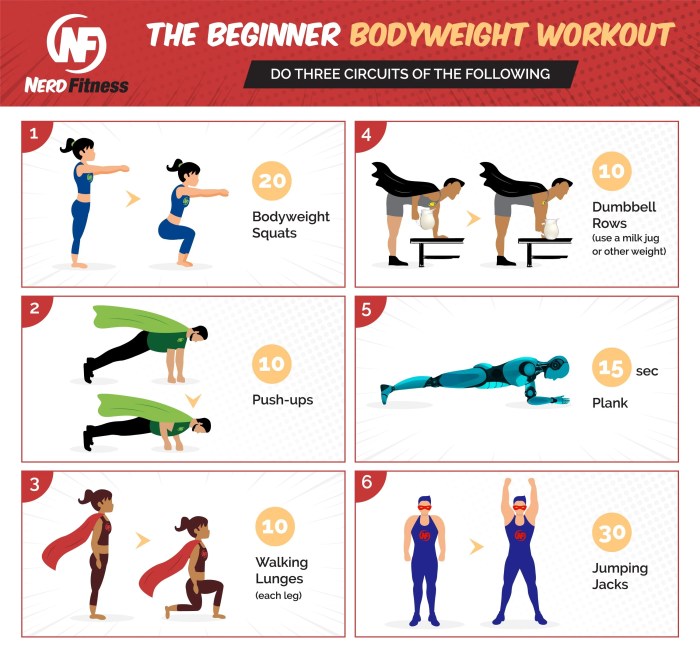
Strength training, often misunderstood as solely for bodybuilders, is a crucial component of a well-rounded fitness plan for everyone, regardless of age or fitness level. It builds muscle mass, increases bone density, and boosts metabolism, leading to significant improvements in overall health and well-being. This section will guide beginners through the fundamentals of strength training using bodyweight exercises and light weights, emphasizing proper form and progressive overload.
A Beginner Bodyweight Strength Training Program
This program focuses on compound exercises, which work multiple muscle groups simultaneously, maximizing efficiency and results. It’s designed for beginners and should be performed 2-3 times per week, allowing for at least one day of rest between sessions. Remember to listen to your body and stop if you feel any sharp pain.
Warm-up (5-10 minutes): Light cardio, such as jogging in place or jumping jacks, followed by dynamic stretches like arm circles and leg swings.
Workout (30-45 minutes):
- Squats: 3 sets of 8-12 repetitions. Stand with feet shoulder-width apart, toes slightly outward. Lower your hips as if sitting in a chair, keeping your back straight and chest up. Push through your heels to return to the starting position.
- Push-ups: 3 sets of as many repetitions as possible (AMRAP). Start in a plank position with hands slightly wider than shoulder-width apart. Lower your chest towards the floor, keeping your body in a straight line. Push back up to the starting position. Modify by performing push-ups against a wall or on your knees if needed.
- Rows (using a sturdy table or chair): 3 sets of 8-12 repetitions per arm. Place your hands on the table, shoulder-width apart, and lean forward, keeping your back straight. Pull your chest towards the table, squeezing your shoulder blades together. Slowly lower back to the starting position.
- Plank: 3 sets, holding for 30-60 seconds. Start in a push-up position, but rest on your forearms instead of your hands. Keep your body in a straight line from head to heels, engaging your core.
- Glute Bridges: 3 sets of 10-15 repetitions. Lie on your back with knees bent and feet flat on the floor. Raise your hips off the floor, squeezing your glutes at the top. Slowly lower back down.
Cool-down (5-10 minutes): Static stretches, holding each stretch for 30 seconds. Focus on major muscle groups worked during the workout, such as quads, hamstrings, chest, and back.
Proper Form for Fundamental Strength Training Exercises
Maintaining proper form is crucial to prevent injuries and maximize the effectiveness of your workouts. Incorrect form can reduce the benefits of the exercise and increase the risk of strains or sprains. Focus on controlled movements and avoid using momentum to complete repetitions. If you are unsure about proper form, consider working with a certified personal trainer for guidance.
Progressive Overload in Strength Training
Progressive overload is the gradual increase in the demands placed on your muscles over time. This can be achieved by increasing the weight, repetitions, sets, or difficulty of the exercises. For example, if you can easily perform 12 repetitions of squats with your bodyweight, you could progress by adding weight (using dumbbells or a weighted vest), increasing the number of repetitions or sets, or trying a more challenging variation, such as jump squats.
This constant challenge is essential for continued muscle growth and strength gains.
Benefits of Incorporating Strength Training into a Well-Rounded Fitness Plan
Strength training offers numerous benefits beyond muscle growth. It improves bone density, reducing the risk of osteoporosis. It boosts metabolism, aiding in weight management. It enhances balance and coordination, reducing the risk of falls. It improves overall functional fitness, making everyday tasks easier.
It also reduces stress and improves mood. By incorporating strength training into your fitness routine, you’ll experience a significant improvement in your overall health and well-being.
Cardio Workouts for Beginners
Cardiovascular exercise is crucial for overall health and fitness, improving heart health, boosting endurance, and burning calories. Starting a cardio routine as a beginner requires a gradual approach to avoid injury and build a sustainable habit. This section Artikels a beginner-friendly cardio plan, methods for monitoring heart rate, strategies for increasing intensity, and the importance of warm-up and cool-down routines.
A well-structured beginner cardio plan incorporates a variety of activities to prevent boredom and target different muscle groups. This variety also helps prevent overuse injuries common with repetitive movements.
Beginner Cardio Workout Plan
This plan suggests three cardio sessions per week, allowing for rest days to promote recovery and prevent overtraining. Each session should last between 20-30 minutes. Remember to listen to your body and adjust the intensity or duration as needed.
Here’s a sample weekly schedule:
- Monday: Brisk walking for 20 minutes.
- Wednesday: Cycling at a moderate pace for 25 minutes.
- Friday: Interval training: alternate between jogging and walking for 30 minutes (e.g., 1 minute jog, 2 minutes walk, repeated).
You can substitute these activities with other low-impact cardio exercises like swimming, elliptical training, or using a rowing machine, ensuring you maintain a moderate intensity level.
Monitoring Heart Rate During Cardio
Monitoring your heart rate helps you stay within your target heart rate zone, ensuring you’re exercising effectively without overexerting yourself. Your target heart rate zone is typically calculated as a percentage of your maximum heart rate (MHR). A simple formula to estimate your MHR is 220 minus your age.
For beginners, aiming for 50-70% of your MHR is recommended. You can monitor your heart rate by:
- Using a heart rate monitor: These devices, either chest straps or wrist-worn, provide accurate real-time readings.
- Checking your pulse manually: Place two fingers (index and middle) on your wrist (radial artery) or neck (carotid artery). Count the number of beats in 15 seconds and multiply by four to get your beats per minute (BPM).
Pay attention to how your body feels. If you feel excessively breathless or experience chest pain, reduce the intensity or stop exercising.
Gradually Increasing Intensity and Duration
Progressive overload is key to improving fitness. Gradually increasing the intensity and duration of your workouts will challenge your body and lead to improvements in endurance and cardiovascular fitness.
Here are some strategies:
- Increase duration: Add 5 minutes to your workouts every week or two.
- Increase intensity: Gradually increase the pace of your walking, cycling, or jogging. For interval training, increase the duration of the high-intensity periods or decrease the rest periods.
- Incorporate hills or inclines: Adding inclines to walking or cycling increases the intensity of the workout.
Remember to listen to your body and avoid pushing yourself too hard, especially in the beginning. Rest and recovery are crucial for progress.
Warm-up and Cool-down Routines for Cardio
Proper warm-up and cool-down routines are essential to prevent injuries and improve performance. A warm-up prepares your body for exercise by increasing blood flow and muscle temperature, while a cool-down helps your body gradually return to its resting state.
A sample warm-up routine could include:
- 5 minutes of light cardio, such as walking or marching in place.
- Dynamic stretching, such as arm circles, leg swings, and torso twists (5-10 minutes).
A sample cool-down routine could include:
- 5 minutes of light cardio, such as slow walking.
- Static stretching, holding each stretch for 20-30 seconds (5-10 minutes). Examples include hamstring stretches, quad stretches, and calf stretches.
Beginning a fitness journey is a significant step towards a healthier lifestyle. This guide has equipped you with the foundational knowledge and practical tools to embark on your fitness adventure confidently. Remember consistency is key, and celebrating small victories along the way will keep you motivated. Listen to your body, adjust the plan as needed, and enjoy the process of becoming a stronger, healthier version of yourself.
Your commitment to well-being is an investment in your future.
Essential Questionnaire: Fitness Plan For Beginners
How often should I work out as a beginner?
Start with 2-3 workouts per week, allowing for rest days to allow your body to recover.
What if I don’t have any equipment?
Many effective exercises can be done using just your bodyweight. This guide includes several bodyweight workout routines.
How long should my workouts be?
Begin with shorter sessions (20-30 minutes) and gradually increase the duration as your fitness improves.
What should I eat before and after a workout?
A light snack before and a balanced meal after your workout will help fuel your body and aid recovery.
What if I experience pain during a workout?
Stop immediately and consult a healthcare professional if you experience any sharp or persistent pain.


